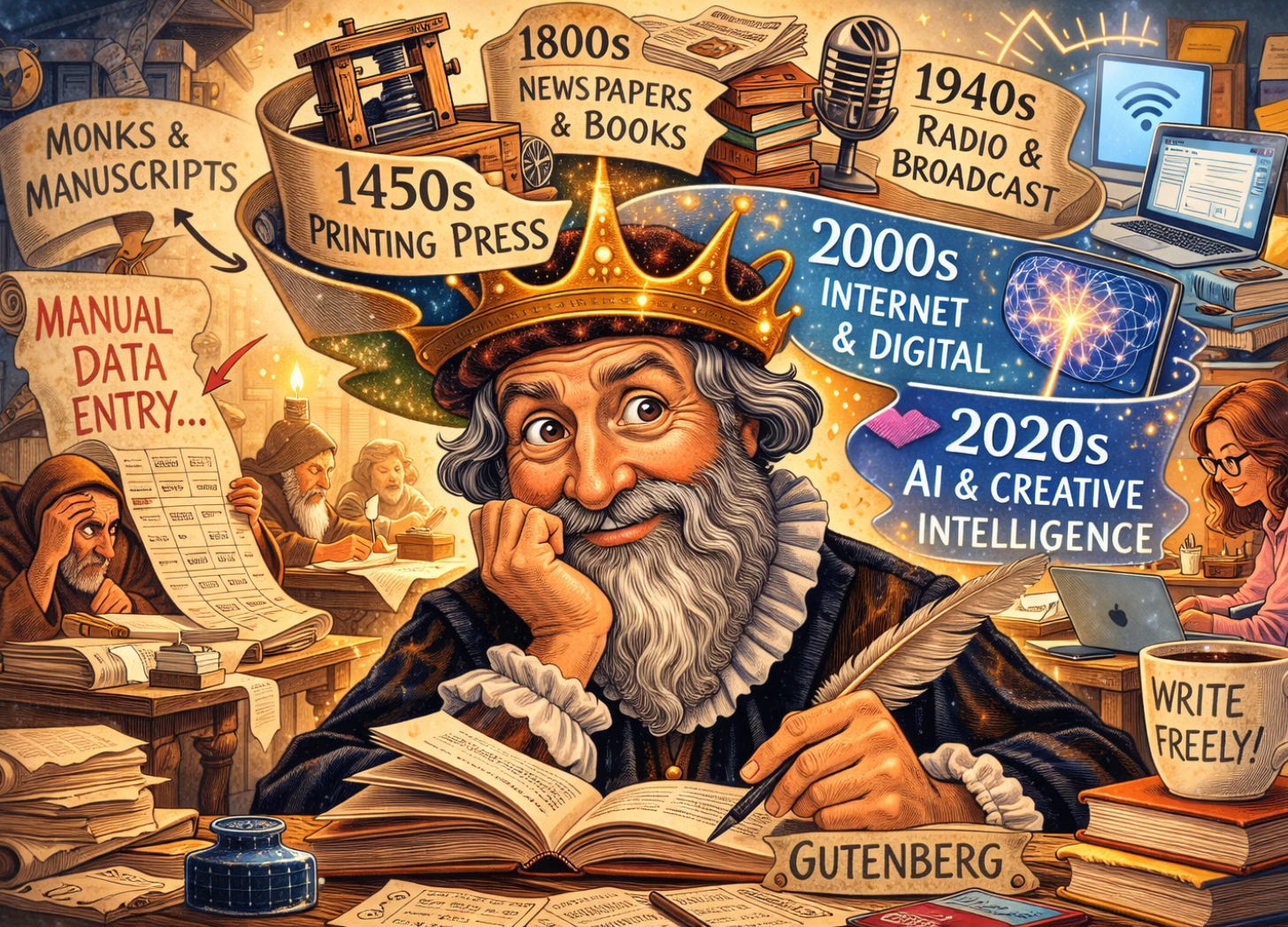
From Gutenberg to GPT
Five Moments When Writers Lost Control Over Their Medium
If Gutenberg were my ancestor, I would need more than twenty greats to reach him. But the truth is, I don’t feel that distance. I feel like I’m sitting in the same room, still working with paper and ink. My fingers guide my pen across the page while emitting a scratchy whisper. Then, I shift my hands to the computer keyboard with its soft clacks before I push publish. Something is always being copied. Something is always being released.
Only now—the letters on the screen think/reflect back.
Regardless of how we feel about AI, it’s here now to evolve with us into the future. If it feels like we are losing control, we are. We’ve been in a repetitive cycle of innovation and its authoritative shifts for the last 500 years.
As creators, we sense something new is emerging. I’m naming it creative sovereignty. We are becoming interpretive authorities over our creative works. And in the weeks ahead, I’ll explore more about what this new form of interpretive authority suggests in relation to opportunities and boundaries. For now, let’s examine five moments in history when writers lost control of their medium, what was lost, and what was gained.
Five Moments When Writers Lost Control of Their Medium
Gutenberg’s Press (1450s)
Before Gutenberg, writing was slow, sacred, and controlled. Books were copied by hand by scribes in monasteries by candlelight. Far from romantic, it was painstaking, tedious work. The Church and universities functioned as gatekeepers of knowledge. Gutenberg’s printing press shattered that order.
Suddenly:
Texts could be reproduced at scale
Ideas could travel beyond institutions
Unauthorized interpretations spread rapidly
Martin Luther’s 95 Theses went viral in the sixteenth century for the same reason a Substack post can travel today: the medium changed the speed of transmission.
For writers, the press was both liberation and loss. They gained audience but lost control over reproduction. Pamphlets, pirate editions, and misprints circulated everywhere.
The gatekeepers (writers/institutions), were no longer the sole authority over the text.
The Rise of Mass Newspapers (1800s)
In the nineteenth century, industrial printing transformed writing again. Steam-powered presses made it possible to print tens of thousands of newspapers a day. Journalism became a mass medium. But this introduced a new authority: the publisher.
Editors decided:
What stories mattered
Whose voice was legitimate
Which ideas reached the public
Writers gained employment but lost ownership of distribution. The newspaper—not the writer—became the cultural authority.
The writer was now part of the machine.
Radio and Broadcast Media (1920s - 1950s)
The next shift removed writing from the page altogether. Radio and television transformed storytelling into voice and image. A scriptwriter could reach millions of viewers but only through networks that controlled the airwaves.
Three companies (ABC, CBS, NBC) dominated American broadcasting for decades. The writer’s role became:
Script contributor
Staff storyteller
Invisible architect of the narrative
Authority migrated again. It went from writer to publisher, to broadcast network. The medium was no longer owned by the creator but by the infrastructure.
The Internet Platform Era (2000s)
When the Internet arrived, writers briefly believed they had regained sovereignty. Blogs, websites, and independent publishing allowed anyone to distribute their ideas.
It felt revolutionary.
But gradually another authority emerged: the algorithm.
Platforms determined visibility through ranking systems. Writers could publish freely but reach was controlled by:
Search engines
Social media feeds
Recommendation algorithms
The writer regained voice but lost discoverability control.
Attention became the scarce resource.
Generative AI (2020s)
Now the shift is deeper.
For the first time, the medium can produce language itself. Generative AI systems are trained on vast archives of human writing. The writer is no longer just competing for attention. They are confronting a new question.
What happens when the medium learns to imitate the creator?
For example, The NYT lawsuit against OpenAI and Microsoft sits inside this tension. It’s not only about copyright and who gets paid. It’s about whether human creators retain authority over the cultural patterns their work helped produce.
The Pattern Beneath the Pattern
Across five centuries, the same cycle repeats.
Printing Press → Authority shifts to reproduction technology
Newspapers/books → Authority shifts to publishers
Broadcasting → Authority shifts to networks
Internet → Authority shifts to algorithms
AI → Authority shifts to machine learning systems
Each historical shift produces fear, anxiety, and rage.
Each historical shift forces writers to renegotiate their role.
Each historical shift asks the same enduring question:
Where does creative authority ultimately live?
The Sixth Turn of the Spiral
Across the last five centuries, every communication revolution has followed the same arc.
A new technology emerges.
It expands the reach of language.
And writers gradually lose control of the medium that carries their words. Each shift relocates authority somewhere else.
But generative AI introduces a strange possibility. For the first time in history, the medium itself can become a collaborator rather than merely a container. The writer can design the system they work with.
Could this be the return of the Sovereign Creator?
Post your comments and questions below. I want to know what you think.


