
The Bot Had a Moment
Talk About Near-Death Experiences
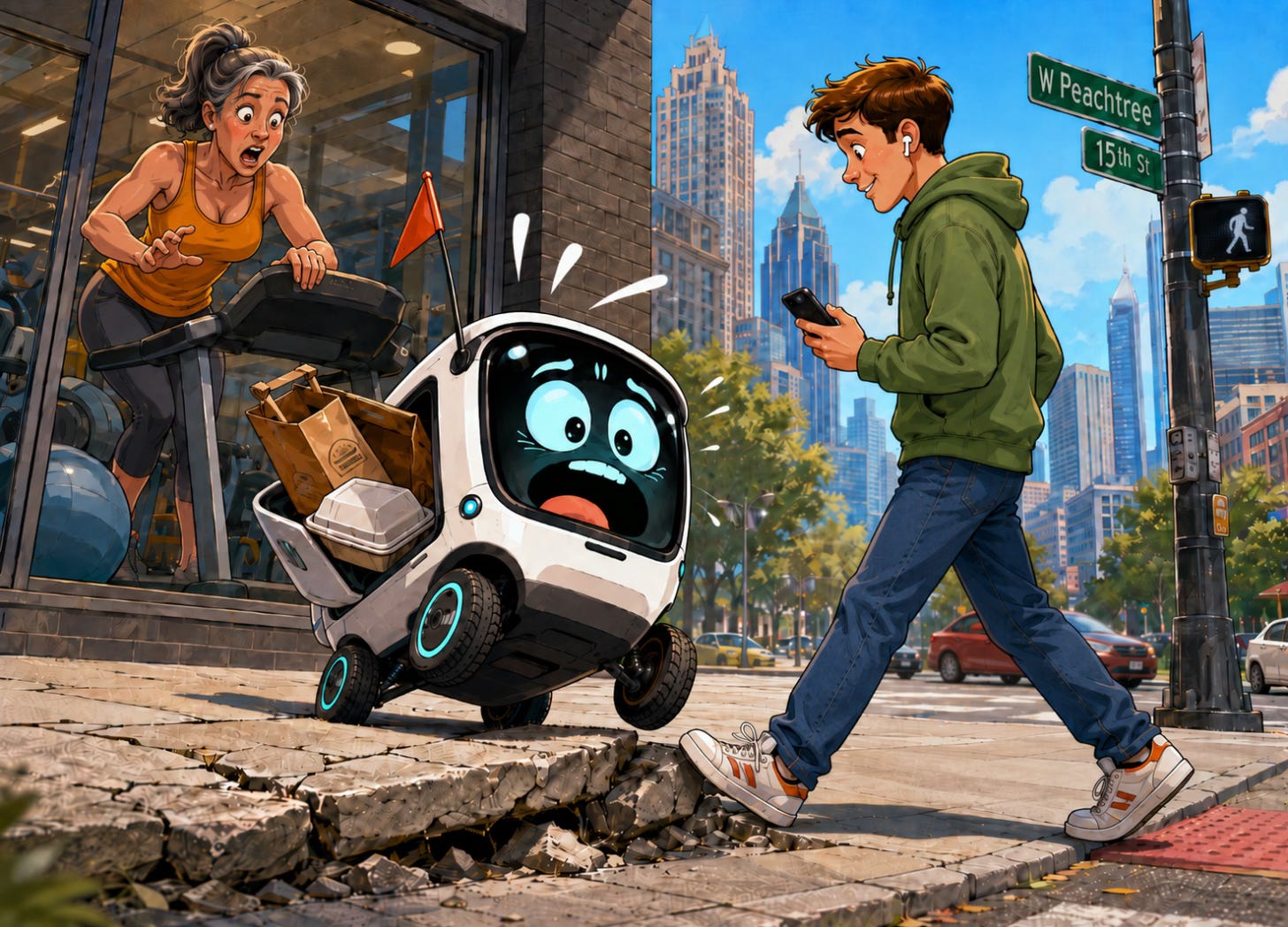
Almost flying on its four tiny wheels, an Uber Eats service robot streaks past my apartment building as if pursued by the ghost of deliveries past.
I’m perched on a treadmill in the gym, walking nowhere and watching everything, when a human being rounds the sidewalk curb and steps directly into the robot’s path.
The robot slams its brakes so hard I can almost hear the voice commands inside its silicon brain shrieking:
Human! Human! Human!
It comes to an abrupt standstill and nearly tips over. Not because it failed to see the pedestrian. It saw the pedestrian. It obeyed the sacred commandment of its tribe: Thou shalt not flatten the human.
The problem was the sidewalk.
Just as the robot braked, its wheels struck the upturned tip of an uneven concrete slab. The whole machine pitched forward in one terrifying wobble, as though it were about to somersault into a smelting pot.
The human meandered by, oblivious.
He was unaware that he had nearly caused a very expensive lunch-bearing robot to overturn simply by walking on two legs at approximately three miles per hour.
But I wondered what I should do.
Should I get down off its treadmill cousin and go outside to comfort it after its brush with—what exactly? Death? Humiliation? A firmware-level crisis of confidence?
Does it possess consciousness?
Is there a 9-1-1 number for service robots in distress?
Should I call Elon Musk?
He seems to know everything. But then again, Tesla’s taxi division is an Uber competitor. He might tell me to remove the bot’s battery, lift the lid, and enjoy the spoils of a free lunch that someone else paid for.
And what about that person waiting for lunch?
I imagine them somewhere nearby, obsessively refreshing the Uber Eats app. Watching the little red circles go round and round while the bot does not move.
Because the bot appears to be having a moment.
And what is that like for a service robot?
After a brush with termination, do all its past deliveries flash across its memory card? The curries. The barbecue wings. The tofu meatballs. The emergency matcha lattes. The pad thai carried bravely through hurricane-force winds.
What about regrets?
Service delivery bots have been around for a few years now, which means this one may already be middle-aged in robot years. Has it begun questioning its purpose? Does it dream of larger delivery routes? Does it resent the salad orders? Has it developed a bestie relationship with another bot from the charging station?
What happens in the privacy of the charging station is none of our business.
But what if there’s a special bot waiting for it? What if a signal needs to be sent? What if the near-tip-over forces a reckoning, not only with mortality, but with love, loyalty, and the fragility of app-based logistics?
This is how the future arrives, apparently.
Not as a sleek demonstration of artificial intelligence gliding effortlessly through the city.
Sometimes the future arrives as a small delivery robot breaking hard on an uneven sidewalk because a human being did what human beings do: wandered into the path of something that had already calculated a route.
The robot saw the human.
But did it see the uneven sidewalk?
That may be the better question.
Because the city is not a clean diagram on a computer screen. It buckles and cracks. Tree roots lift concrete. Shurbs transform corners into blind spots. And somewhere between the mapped city and the reality of a human-embodied city, a robot nearly tips over.
So yes, we may need to start paying closer attention to where we’re walking.
Not because the robots are taking over.
But because one of them may be carrying someone’s lunch and having a very difficult day.


