
The Threshold Guardian
What the Dragon Asked of Me
The outdoor temperature in Atlanta chills the bones like a New York Polar Express. Yet in my sunny imagination, it feels like a perfect day to visit the zoo. We have the place almost entirely to ourselves. I wonder if the animals prefer it this way—cold air, fewer humans roaming the paths.
It’s so cold my thoughts drift from elephants munching hay to human comfort food. With a few taps on my phone, I place an order for coffee and bagels from Zabar’s in New York for next-day delivery in Atlanta. Instant gratification, neatly packaged. Tomorrow morning, coffee and bagels. Yum.
Then something clicks. The Kenyan coffee beans I’ve just ordered come from the homeland of the magnificent being standing before me. And I can’t help but ask: how does my desire for speed and comfort contribute to elephants losing their habitat to expanding coffee plantations?
A wave of shame washes over me. I take a breath. Step forward.
And then I walk straight into the realm of a threshold guardian.
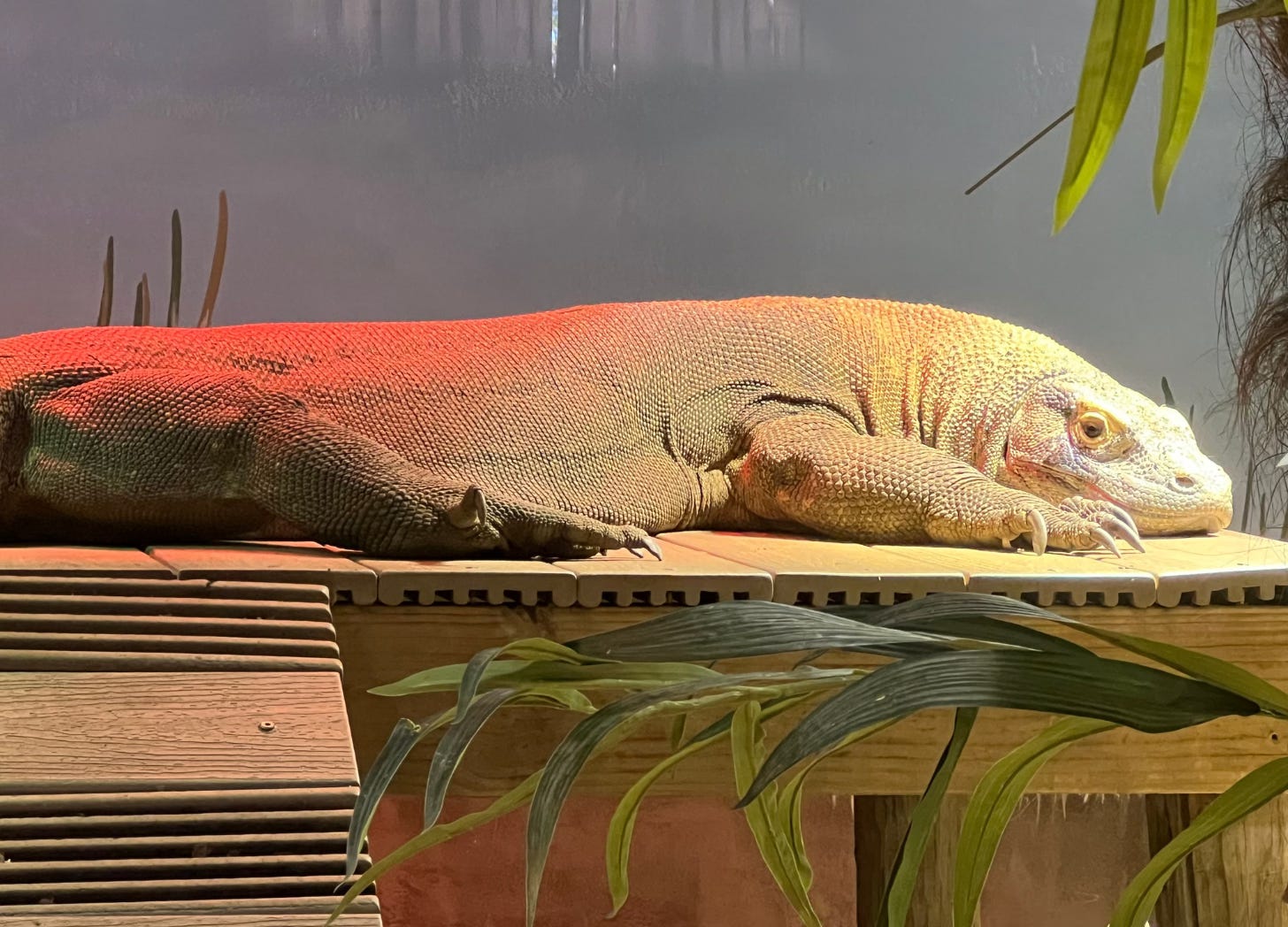
A Komodo dragon.
The Komodo dragon does not flinch at my arrival. He lies beneath a heat lamp, immense and unmoving, his body positioned with unmistakable precision. The warmth pools over his core, over the organs that matter most. His hide catches the red-orange light and gives it back, scale by ancient scale, as if reminding me that survival is not a performance but a practice. His claws—razor sharp, curved inward—are not raised or concealed. They are simply held. Nothing about him rushes to resolve my discomfort. He does not ask me to be better, faster, or purer. He waits. And in that waiting, something in me slows enough to notice: power, here, is not about appetite or acquisition, but about restraint. It’s about knowing exactly how much energy to spend, and when.
There is an origin story from the Indonesian islands where Komodo dragons live that returns to me as I watch the dragon’s gaze. A Mother gives birth to twins: one human, one dragon. The people are instructed to protect the dragon as kin. To harm it would be to harm themselves. The story does not pretend the dragon is harmless. Instead, it insists on relationship. Power, the myth suggests, becomes destructive only when kinship is forgotten. Destruction becomes normalized when what is closest is treated as expendable. Standing there in the dragon’s presence, I feel the quiet weight of that instruction. Not conquer. Not consume. Remember who you are related to.
I look again at the dragon’s body and understand why the myth needed flesh. He is built for solitude. His sand-pebbled bony hide is heavy, grounded, self-contained. Nothing in him seeks alliance or affirmation. His power does not come from numbers or bonds, but from an uncompromising relationship with limits. He weighs hundreds of pounds, yet wastes nothing. His jaws hold a force that could end life, yet remain closed. His eyes track movement without chasing it. Even his stillness has structure. This is a body that knows exactly what it requires to endure. Watching him, I sense the difference between restraint and repression. The dragon is not denying his power. He is regulating it. And that, I realize, is what makes him dangerous and worthy of protection.
And yet the Komodo dragon is now endangered. Not because it failed to adapt, but because the world around it accelerated faster than restraint allows. Rising seas swallow nesting grounds. Habitats narrow. Margins thin. The dragon still knows how to wait, how to regulate energy, how to survive within limits. What’s faltering is not the dragon’s intelligence, but the conditions that once honored it. Standing there, I feel the ache of that mismatch: a creature shaped for deep time now negotiating shallow decisions made at scale.
The dragon does not accuse. He does not plead. He remains under the heat lamp, doing what he has always done—positioning himself carefully so life can continue. And I understand, then, that the origin myth was never only about dragons. It was a human instruction disguised as a story. To remember kinship.
We are not dragons. We are communal beings, dependent on neighbors, ecosystems, and one another. “Love thy neighbor” is not sentiment; it is survival literacy. It is the restraint that keeps power from consuming its own future. As I leave the enclosure, the dragon has not moved. He doesn’t need to. He has already influenced the outcome by slowing me down.
What kind of power is worth practicing, and what kind of kinship is worth protecting?


